

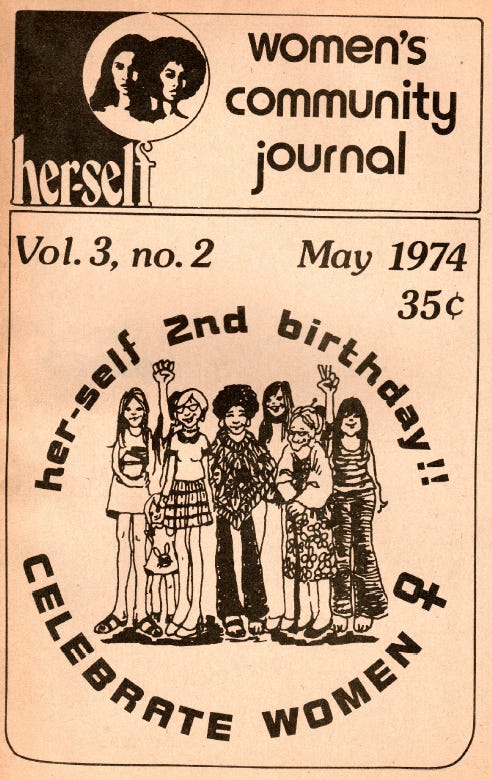
Once upon a time in the mists of history, I was a college-age feminist working on an alternative newspaper called her-self in Ann Arbor, and involved in the University of Michigan chapter of Women in Communications. With the ambition of youth, a co-op housemate and I somehow managed to organize a regional conference and invited important women journalists from all over, including then two-year-old Ms. Magazine.
Sadly, we were unable to snag Gloria Steinem for that March 1974 conference. But we did persuade Ms. to send another founding mother from New York, and the gathering — intended to assess the progress of women in media — was both an eye-opener and a hit.
There is really no way to overstate the significance of Steinem & co. to my generation of women. At the time, I was volunteering on her-self instead of the Michigan Daily. It was a boneheaded move in terms of meeting anyone who could later help me break into mainstream journalism, but I wasn’t thinking like that then. And the experience proved useful in ways I could not anticipate.
I was no stranger to the women’s movement by then. I had read Sisterhood is Powerful as a teen-ager, and after a junior year in Dublin, I chronicled the struggle of Irish feminists in a her-self article that borrowed their movement slogan for its headline: “Irish Women: Chains or Change?”
My first big decision was to “change the system from within.” That is, get a job in traditional media. The second big one was to try to be a political reporter, a field almost completely dominated at the time by men.
All of this was a whole lot easier said than done with my music literature degree. But I did have a senior-year job in Michigan as a feature writer for the weekly Plymouth Community Crier, along with assorted other clips from normal places (a health care weekly, a neighborhood newspaper) when I moved to Manhattan after college.
After superseding that music degree with a journalism masters degree from New York University and doing well on a skills test, I landed a job with UPI in Charleston, West Virginia. A lot of that two-year stint (starting with the move from Greenwich Village to Appalachia) was memorable.
There was culture shock, to be sure, but there was also an incident that probably could have happened anywhere at that time: I went into the local bank to get a credit card, and the bank said no.
Young men I knew, men my age, received multiple credit card solicitations in the mail every week. Some even got actual preapproved cards while in college (my husband among them). That had never happened to me, and now I was smacked in the face with the reason. I remember telling the naysayer he was refusing me because I was a woman, that in fact I was a union employee making exactly the same amount as the men I worked with (something like $14,000 a year back then), and oh, by the way, I was a reporter.
Reader, I got the damn card.
I joined the Associated Press in Harrisburg, Pennsylvania, in 1979, just in time to cover the Three Mile Island nuclear accident — and the start of a years-long legislative fight over gender-based auto insurance rates (Pennsylvania is now one of seven states that prohibits gender as a factor in rate pricing).
In that era, akin to a temporary Age of Enlightenment in a Republican Party from another planet, I also remember covering Pennsylvania Gov. Dick Thornburgh and his wife, Ginny, participating in a march for the Equal Rights Amendment.
A few years later, when I was a regional reporter covering Pennsylvania issues and people in DC, several AP women filed a complaint with the Equal Employment Opportunity Commission. One man in my office scoffed to me that I had never encountered sex discrimination. But how would he know? In some cases it was subtle, but it was there, in (sometimes unconscious) paternalism or raises that didn’t happen.
It was a learning curve for everyone. The EEOC complaint soon resulted in a handful of women promoted to the national desk in Washington. Eventually I, too, would make it to the national desk. Within a year I was being treated so equally that when Lebanon released American hostage Benjamin Weir, I was sent to cover his press conference — at eight months pregnant. Which was just fine with me.
That was one kind of milestone. Another kind came during the 1992 presidential campaign, when my byline went from “Associated Press Writer” to “AP Political Writer.” I was the first woman to have the title, and I’m happy to say there have been plenty more since then.
I’m pretty sure I was born a feminist, a writer, and a political junkie. I wasn’t born particularly self-confident, though, and I’m not certain I would have had the confidence to go for these goals without the role models of my formative years — and Gloria Steinem in the forefront of an entire movement, assuring me and millions of other girls and young women that yes, we could. We absolutely could.
In case you missed it:
August 25: Dolly Parton, 1946-2026 (speaking of a woman who absolutely could)
I FIRST TUNED IN TO DOLLY PARTON in the late 1970s. I had moved from Greenwich Village to Charleston, West Virginia for a job (yes, really), and going to hear her live seemed like the thing to do. This was in her giant hair, giant boobs, giant bellbottoms phase. But oh my God, that voice. Those songs. I was hooked for life.
There are three generations of classical music aficionados in my family, including me. But country music called to me. For the melodies, the voices, the stories, and, yes, the simplicity.
August 25: Donald Trump’s Summer of Screwing Our Allies
WHERE DO I LINE UP to get Canadian citizenship?
Kidding, not kidding. Americans have sought refuge in Canada for all kinds of reasons over the centuries. Fugitive slaves crossed the border to avoid being returned to their owners. Later came tens of thousands of Vietnam War resisters. Now it’s common to hear Americans talk about moving there to escape the Trump administration, and some are actually doing it.
Leaving Donald Trump behind is an excellent reason to relocate north of the border, and I can’t say I’m not tempted—especially now. That’s because Prime Minister Mark Carney just exposed Trump’s absurd delusions of conquest with a series of hair-raising details about the trade negotiations that began over a year ago.
August 18: This year, the keyword for Democrats is ‘competence’
As centrist Democrats mobilize for battle against the Democratic Socialists of America, and as that group’s platform envisions an America unburdened by borders, the Senate and the Constitution, I find myself dreading this conflict and desperate to avoid it.
And I think I’ve found a way. Mister Rogers used to say “look for the helpers.” This year and in 2028, the Democratic message should be “look for reality-based fighters committed to facts, truth, accountability and renewal.”
It’s not as tall an order as it sounds. A good example is 314 Action, which endorses candidates up and down the ballot, from city council to Congress, in every shade of blue across the Democratic spectrum.
Jill, your last paragraph really hit home for me. I’m 64 and absolutely benefited from 2nd wave feminism in sports, employment, and life in general. In 7th grade I received a “women’s libber” award, which, I think, was supposed to be a sort of joke from my friends, but I took that thing seriously. I am proud to be a strong, independent woman in the middle of a line of independent women. Thank you, Gloria, and thank you, Jill.
Speaking as an old white guy who has spent a lifetime in elementary education, a world that was and remains largely female, my reaction to any male backlash against women's rights is that it is, above all else, just surpassingly stupid.
I've spent a lifetime working under, with, and over a substantial number of remarkable women. At no time did I ever feel that being a man gave me some higher level of intelligence, ability, or superiority. Indeed, there were not a few times when I knew I was at best second best in all those areas.
Did I find that some of those women were at times frustrating and/or incomprehensible. Sure, as I know they sometimes found me as well. But my life would have been far less rich, less enjoyable, less entertaining, less funny, less challenging, and less worthwhile had it not been shared with my female colleagues.
The concept of women as less than equal to men can be described in many negative ways, but to me, to do so remains primarily just plain stupid.
The fact that so many women, including Ms Steinem and so many others had to and still have to struggle against this utter stupidity continues to baffle me. We are two halves of a whole humanity. Beyond any legal or moral questions, of which there certainly are many, those who fail to see that are much the poorer for it.